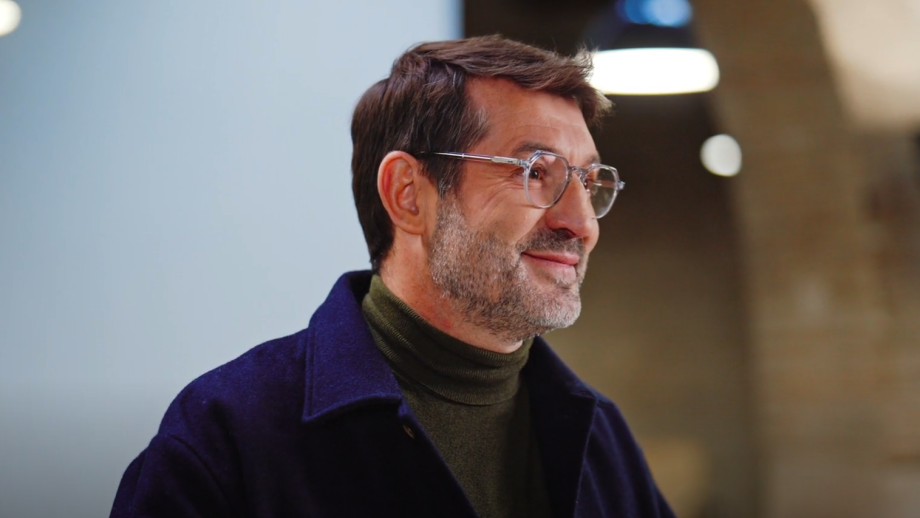
For the fourth instalment of the series, we speak to Guillaume Pouthier, Managing Director and winemaker at Château Les Carmes Haut-Brion. Located in Pessac-Léognan, the estate is uniquely situated on the urban outskirts of the city of Bordeaux. Guillaume arrived in 2012 bringing with him a technique rarely seen in the region at the time: whole-cluster infusion instead of extraction. Since then, he has been named France's Best Winemaker by Le Figaro Vin in 2023, and has overseen the estate's striking new Philippe Starck-designed winery, which combines function with elegance.
Guillaume shares his opinion on the benefits of infusion versus extraction, who Bordeaux wines are appealing to in the modern day, and how precise water management shapes the character of a truly great vintage.
Ella Lister: On the outskirts of Bordeaux, Les Carmes Haut-Brion embodies a resolutely contemporary vision of wine. The estate is rethinking viticulture and winemaking, balancing technical daring with respect for living things. Let's welcome Guillaume Pouthier.
It's impossible to be more Bordelais. Les Carmes Haut-Brion is the only château located within the city limits of Bordeaux. Do you need to be at the heart of Bordeaux to better reinvent it?
Guillaume Pouthier: I'm not sure you need to be at the heart of Bordeaux to reinvent Bordeaux wine. Today, there are an enormous number of great wines in Bordeaux, so I just think that being at the heart of Bordeaux helps us achieve the ripeness we're aiming for in slightly cooler vintages. Otherwise, I think great Bordeaux wines can be made almost anywhere. In fact, our vineyard is split between one part in the city centre and one part outside Bordeaux. I think today's great Bordeaux wines, over the last decade or so, have everything needed to appeal to every kind of audience, whether younger or older. And they have everything to appeal to drinkers of any nationality, whether English or American, who tend to enjoy slightly more structured wines. I think we're making wines today that are balanced, complex, and rich, which allow us to keep Bordeaux's DNA and its aging potential, while also allowing them to be drunk much earlier, and so to take their place among the world's great wines.
EL: Guillaume, you often talk to me about infusion rather than extraction. But how does this approach change the texture, balance, expression, and taste of the wine?
GP: To create a real infusion – like tea – you have to keep what we call the marc "locked under," meaning the skins stay submerged throughout the entire alcoholic fermentation, so there's constant juice-to-skin contact. This actually extracts a large part of the wine's final tannic structure, drawn from the grape skin, which in my view allows for a little more softness and velvety texture, giving a slightly fuller shape on the palate.
EL: You've dared to use whole-cluster harvesting and submerged skins. Why this choice, and what does it bring to the wine's identity?
GP: Actually, this choice came from the idea that a great wine has a singularity, something unique about it. For me, the real luxury of a great wine is being able to choose when to drink it, rather than having the vineyard or winemaker impose its own drinking window. When I tasted great vintages of Carmes Haut-Brion from the 1940s and 1950s, that whole-cluster character was already there. So I simply wanted to reproduce that effect today – with the ripeness we can achieve in recent vintages, it allowed us to bring in that same sense of freshness and singularity, which interested me. So I tested it in 2013, in a difficult vintage. The result was, for me, exceptional given the vintage conditions, and so I wanted to carry it forward, refining it year on year, especially from 2015 onwards when we got a new cuverie. I think the effect snowballed, to the point that today we have a genuine signature at Carmes.
EL: And speaking of which, this new cellar designed by Philippe Starck made a real impression with its boldness, but beyond the design, how has it transformed the way you work the wine?
GP: This cellar has helped us a great deal on several levels. First, as you say, it's a work of architecture, but beyond that, it's a cellar that has given us real comfort in our work, both in terms of safety and in terms of versatility.
EL: So specifically, how do you technically manage water stress?
GP: The greatest vintages are made with moderate to strong water constraints, because each grape variety has its own water requirement right up until harvest. So to try to measure and optimise water stress, we work with several factors. There are cultural factors – for example, exposed leaf surface: our vines are trellised, and we manage the canopy to be more or less dense, more or less tall. Between the rows, we leave grass, using different types depending on the plot. We also adjust a lot of our working processes – for example, working in the morning or the evening to optimise this water stress.
EL: Finally, if you had to picture the estate of tomorrow in twenty years' time, whether in Bordeaux or elsewhere, what would it look like, in your view?
GP: The estate of tomorrow, for me, is exactly the estate of today, but perhaps with a bit more definition, more specialisation in crafting great wines of place. "Places," plural.
To watch (and read) the full interview in French, follow this link to Le Figaro Vin's website: Domaines de Demain: Les Carmes Haut-Brion