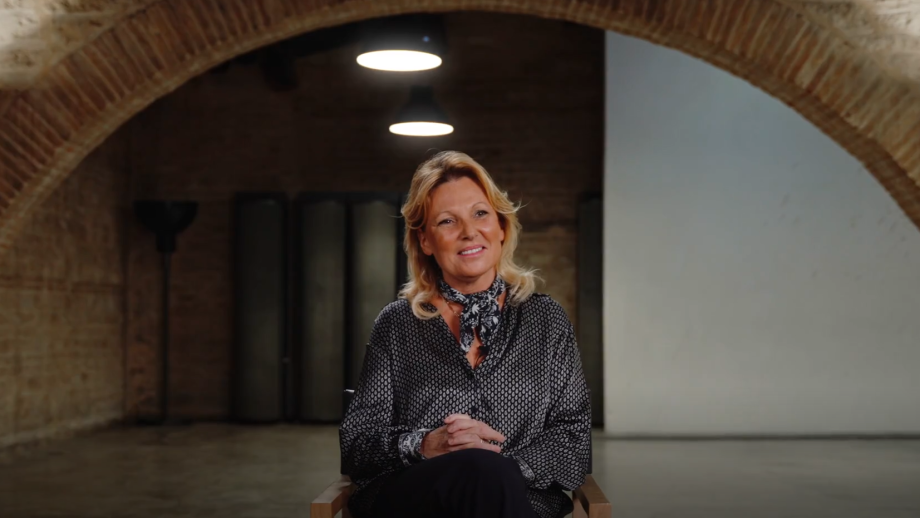
For the final instalment of our 'Domaines de Demain' series, we meet Carine Riccobono, owner of Domaine des Perchés, situated in Cadillac-sur-Garonne. Representing the eighth generation of her family to work this land, Carine returned in 2019 to revive a vineyard that had been left dormant for two decades, rebuilding it from scratch alongside her son Marius. Today, the vineyard has been reimagined as a place where winemaking, art, and biodiversity coexist.
Carine reflects on what she calls a "maternal" approach to viticulture, the role art plays throughout the estate, and why breaking with Bordeaux convention felt like the only way forward.
Ella Lister: Beyond the conventional Bordeaux, on the hillsides of Cadillac, Domaine des Perchés cultivates freedom. A place where vines, art and nature flourish, far from established norms. Let's go and meet them.
Domaine des Perchés is a true family renaissance in Cadillac-sur-Garonne, with an approach deeply connected to nature. What guided your desire to bring this land back to life?
Carine Riccobono: It's passion. These are my roots. This is the land of my ancestors, eight generations. My son will be the ninth generation. And this passion for wine, this passion for cultivation, for terroir. In 1999, my father had a health problem and asked me to take over the estate then and there. But I was living in the Camargue then, with very young children. I couldn't take it on. He uprooted about fifteen hectares. The rest he leased out. And these lands, as I said, had not been worked for more than 20 years. He passed away in 2019, and by then, the children had grown up. Marius wanted to come and work a little at the wine estate. So I said, "Why not? Let's do it – but let's do it differently. We'll break with the norms of Bordeaux, make a wine that reflects us, and gain our freedom."
EL: You describe your approach as feminine viticulture. How does that translate in your actions, your decisions, your view of the vine?
CR: A feminine viticulture… I would say even more than that, a maternal viticulture. I rebuilt this estate. We started again from a blank page, on terroir, land, plots that had not been worked for more than 20 years. I observed, I chose my grape varieties, and took the time to listen to them, to watch them grow, and understand them. There is a very maternal side to it. That connection between earth and mother, the nurturing mother. Because as I said, it's about transmission. A story of transmission. A transmission to my son. So there's something protective, calm, transparent, and luminous. We only have four and a half hectares, so everything is done by hand, in small vessels, so each grape variety is treated like a small jewel. We managed to recreate biodiversity, bringing back endemic species. There is also everything related to terroir – the soil, human work, and the climate. All of this means the wine is alive and natural.
When people saw me return to Cadillac at that time, and break all these norms, once, then twice, they said that I must be high. And since I wasn't alone in this adventure, I called it Domaine des Perchés.
EL: So that's why?
Exactly. And as we are also overlooking the Garonne, on the beautiful hillsides of Cadillac, we are also a little high in terms of the hills.
EL: Art is omnipresent at Domaine des Perchés, in the vineyards as well as in the cellars. What place does it hold in your work as a vigneron?
Wine is an art. Making wine is an art. From the moment you open the gates of the estate, two enormous sculptures welcome you – the Tree of Life and the Sculpture of Knowledge. But beyond that, when you enter the winery, I wanted everything to be transparent, so we installed lots of stained-glass windows. These stained-glass windows are living works of art, which, depending on the light, change colour and atmosphere. I have my technical vinification cellar. And next to it, I have the aging cellar that I call "my chapel." And beyond that, it even extends to the labels on the bottles. We also work with the stars. So we turned to the Marseille Tarot. For 2023, there is one tarot card and the reverse of a second card. That second one is turned over in 2024, to represent an event at the estate. For example, in 2024 we planted more than 300 olive trees and installed five beehives. So it represents symbiosis between the olive trees, the beehives, and a small frog – because it was a leap year.
EL: Finally, if you had to imagine the estate of the future 20 years from now, whether in Bordeaux or elsewhere – what would it look like to you?
I imagine an artist's studio, a place for artists to be free, where everything is a masterpiece – from the vine stock to the wine itself. And these masterpieces should make us feel something, should make us dream.
To watch (and read) the full interview in French, follow this link to Le Figaro Vin's website: Domaines de Demain: Domaine des Perchés