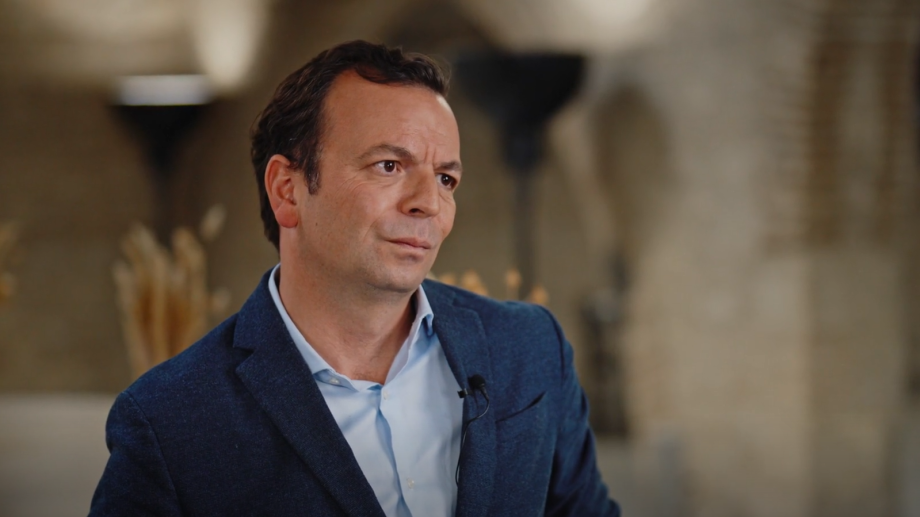
For the latest instalment of the 'Domaines de Demain' series, we speak to Jean Garandeau, Sales and Marketing Director at Château Latour, who joined the estate in 2010. Château Latour's pursuit of excellence has remained uncompromising since the 14th century, and in 2012, under Jean's watch, the estate took a momentous step – leaving Bordeaux's historic en primeur system to release its wines only once they are ready to drink.
Jean explains the rationale behind trading immediacy for patience, what the shift means for négociants, sommeliers, and collectors, and his vision for the estate's future – "first and foremost, a story of people."
Ella Lister: Château Latour embodies a new way of thinking about selling Bordeaux's Grands Crus. No longer selling our wine en primeur, but when it is ready to drink. A bold choice that places time at the heart of luxury. Let's meet Jean Garandeau.
In 2012, Château Latour left the en primeur sales system, an emblematic and above all historic model in Bordeaux. Could you tell us about the underlying reasons behind this decision?
Jean Garandeau: The fundamental reason, the one that inspired us when we made this choice, was above all to offer the best possible experience to those who do us the honour of tasting our wines. At the time, we felt somewhat frustrated to see our wines being consumed far too early, far too young. That is why we decided to age them for longer at the estate, so they could reach a more advanced stage of maturity before being released commercially. Take the 2017 and 2016 vintages, for example. Last year, we chose to release the 2016 vintage, which is very refined, very structured, very dense, after 2017, a vintage with vibrant fruit and great charm.
JG: Time is certainly our greatest ally. It shapes flavour and anchors the memory of a style. Ultimately, time operates on three levels. First, the time required to bring a wine into being. Take the vineyard as an example. When we decide to replant a parcel, we must wait several decades before producing a great wine again. Time is also about transmission – passing down centuries-old savoir-faire from one generation to the next. And then there is the time necessary for ageing – of course ageing in barrel, but also in bottle. Finally, there is the time for experiencing – the moment for sharing, which is a moment suspended in time.
EL: This model also requires significant work in terms of storage and monitoring. How did you implement it in practice?
JG: Indeed, this model required the construction of new cellars here at the estate. It is a place that is quite spectacular in its verticality and in its scale too. And then, within these cellars, there is a sense of calm, a serenity necessary for the rest and development of our wines.
EL: What does this change for the négociants and for consumers?
JG: First of all, wine lovers around the world are nowadays possibly a little less patient than they once were. They also probably have a little less space to store their wines. In that sense, this way of releasing the wines undoubtedly meets some of the needs, and also the norms of our time: which are, after all, to enjoy wines sooner, without waiting as long. We also offer perfect provenance. Today, in effect, wines may travel and be transported to the four corners of the world. And with this system of delayed release, we provide certainty that the wines have aged in perfect conditions in our cellars, with temperature and humidity levels constantly controlled. This allows them to mature in excellent conditions. So, when wine lovers are able to obtain our wines, they know with certainty that these wines have been pampered and protected, because the wines remain at the estate for six to eight years for Les Forts de Latour, eight to ten years for the Grand Vin, and for our Pauillac de Château Latour, between four and six years. This allows them to reach a level of maturity that already offers great pleasure.
JG: It also changes many things for restauranteurs, our sommelier and chef friends, because they can place these wines directly on their lists without having to bear the cost and find the space required to store them.
EL: Finally, if you were to imagine the estate of the future in 20 years, be it in Bordeaux or elsewhere, what would it look like in your opinion?
JG: The estate of the future, in 20 years, if I take the example of Château Latour, will first and foremost be a story of people. People who must continue to cherish the heritage, and also continue to nurture the DNA of the terroir, to preserve the singularity of the wines, so as to offer the greatest emotion possible in the glass.
To watch (and read) the full interview in French, follow this link to Le Figaro Vin's website: Domaines de Demain: Château Latour