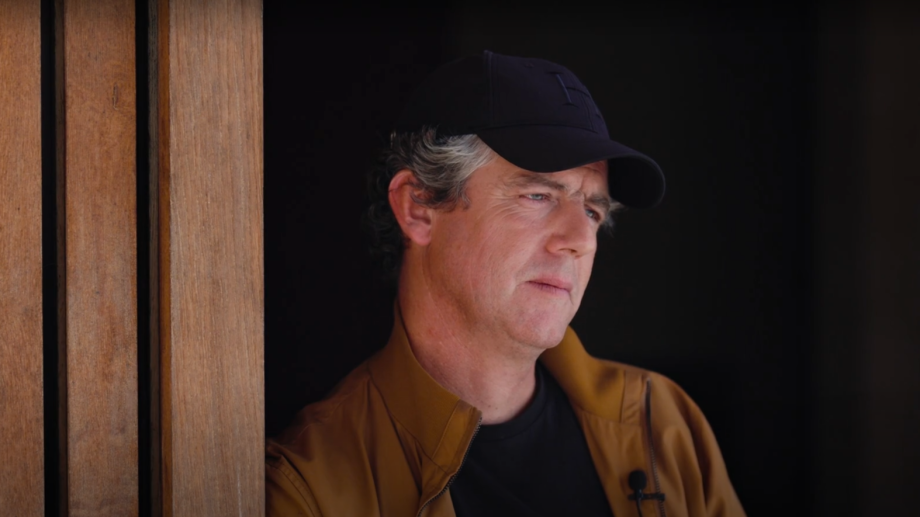
For the fifth instalment of the 'Domaines de Demain' series, we speak to Baptiste Guinaudeau, who runs Lafleur alongside his wife, Julie. Located on Bordeaux's Right Bank, the estate has remained a single, unified plot since its beginnings – just 4.5 hectares, tiny by Bordeaux standards. In 2025, Lafleur made international headlines with a rare move to leave the Pomerol appellation, granting greater freedom to farm in innovative ways in the face of a rapidly changing climate.
Baptiste discusses why leaving the appellation is far from a departure, how the estate blends data with intuition whilst making decisions, and the radical water strategies which shape Lafleur's future.
Ella Lister: In Pomerol, Lafleur chooses freedom. Leaving the appellation to continue innovating. A rare move, faithful to the estate's pioneering spirit. Let us welcome Baptiste Guinaudeau.
Lafleur is often described as a singular estate. But who are you really today?
Baptiste Guinaudeau: The word that defines us best is "farmers." Farmers, because we are the owners, we're fortunate to own, to live at, and to work at Lafleur every day. Lafleur's singularity is that it has always been the same single plot from the beginning. A big garden – not an estate, and even less a château. It's a large garden of four and a half hectares, which is very small by Bordeaux standards.
EL: From the 2025 vintage, you left the Pomerol appellation. What do you hope to gain from this?
BG: The first point is that we did not leave Pomerol. We simply gave up the appellation. It is by no means a departure; on the contrary, we have never felt more Pomerolais. It is this singular taste of Lafleur that defines Lafleur. And today we have the privilege of interpreting it. Others came before us, and others will come after us. Our idea is simply to do everything in our power to preserve the taste, the true identity of Lafleur.
EL: How are decisions made at Lafleur?
BG: Decisions and questions are the daily life of a vigneron. A decision always begins with intuition, then we follow it, we build it and we root it in data. But in the end we go with our gut, because data does not have an answer for everything. So in the end, to decide, we come back to intuition, in other words the second slice of bread. A data sandwich.
EL: In the face of climate change, you have undertaken numerous experiments. How does this constant search for solutions redefine your freedom?
BG: We have always felt very free. In Pomerol, as you know, there is no classification. It's a very recent story. This step aside, ultimately, came naturally. Climate change has been around for roughly twenty years, but in reality, it's about fifteen vintages. And for us, it was really in 2010 that this discomfort, this unease began.
EL: If we fast-forward to 2025, what accelerated this decision?
BG: Nothing accelerated this decision, it's a decision that came naturally. From 2010 to 2024, we learned, we tried to understand. And in fact, we talked much more about replenishing the soil with water than about irrigation. In the end, we are not addressing the vine itself, but the soil that hosts it. Only in 2025 did we decide for the first time to truly take action. Because by the time spring 2025 came round, we were convinced that the drought would be intense, very profound, and very long. And with this conviction, supported by data accumulated over the past 15 vintages, we decided for the first time to move from experimentation, from "I seek" to "I act." Because climate change, in the end, is full of opportunities if we're ready. We did what any farmer anywhere in the world might be forced to experiment with: the very precise provision of water, allowing us, on a few vines, to observe their reaction and to assess our potential ability to compensate for excessive drought. The vine is a Mediterranean plant that can tolerate – and we actively seek out – a certain lack of water, a certain hydric stress in summer, to build structure and fine tannins. Long before the vine becomes thirsty, it is actually the soil that becomes thirsty. A soil is a biotope inhabited by tens of thousands of tiny organisms that sustain soil life, and it is from a living soil that we produce living grapes that will make living wines.
EL: And how does irrigation work in practice?
BG: We act in a really very, very gentle way. We provide water, we provide small quantities of water, so we don't need pipes or large pumps. It's extremely targeted, so it's not even all the rows of vines, for example, that will be our target – it might only be a section of a row of vines in a very specific place, that we know is under greater stress and unable to retain water. So it's what you might call a human-mechanical system: a tractor designed to carry water and bury it underground, sheltered from the air, around 10cm deep – so it's a very simple system, very much a farmer's solution. A single vine at Lafleur this summer consumed less water than a tourist on the coast in half a day.
EL: You now have the right to irrigate because you are no longer part of the Pomerol appellation, but water is becoming increasingly scarce. How do you reconcile this freedom with this responsibility?
BG: We decided to invest in a small property that was built around the time of phylloxera. We only capture winter overflow water that we store and transport. So we are completely independent from the water network. And that is only right, it's how it should be. Any responsible farmer preparing for the future today should move in that direction.
EL: Is this, then, what an estate of tomorrow looks like?
BG: Perhaps it is. A winery that knows where it comes from, its history, and that is highly conscious of being the custodian of a unique taste.
To watch (and read) the full interview in French, follow this link to Le Figaro Vin's website: Domaines de Demain: Château Lafleur