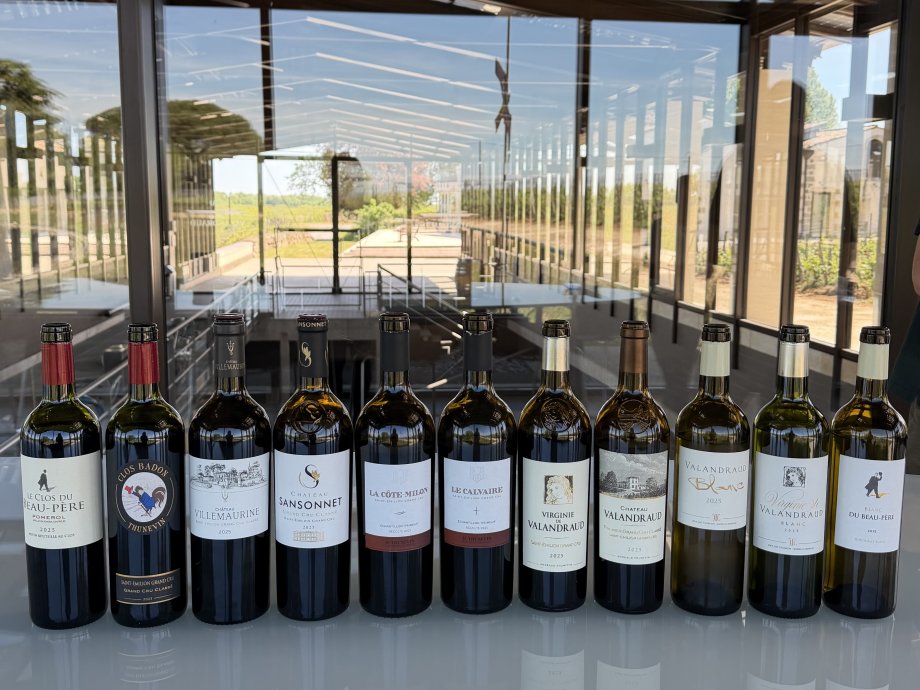
With the Bordeaux en primeur campaign now in full swing, we share our verdict on the new vintage after nine days tasting in Bordeaux.
We asked Nicolas Sinoquet, CEO of Château Gruaud Larose, to describe the 2025 vintage, and he told us, "When I have it in my mouth it makes me feel good, it's emotional," adding, "It’s the best wine we have made since I've been here." After 13 years at the château, that's a bold statement, considering recent mythical vintages such as 2019 or 2022. But 2025 has something about it, something completely original – a sophistication and a digestibility that are not only irrevocably modern but also entirely improbable.
"It's almost an oxymoron," confides Hubert de Boüard, co-owner of Château Angélus, for while the climatology resembled that of hot vintages such as 2009, 2010, or 2022, "the wine has nothing to do with them." On the other side of Saint-Émilion, Nicolas Thienpont is more definitive, calling 2025 an " oxymoron par excellence," thanks to its combination of richness and acidity. "Four days before harvest you might have expected extremely compact wines, marked by excessive concentration, but in the end we have this vibrant, svelte quality that makes you salivate," he enthuses.
"The key to the vintage is that there is very little volume"
Anyone who spent their August holidays in the southwest will remember vividly the mid-month heatwave, which topped 40 degrees in the Bordeaux region. The 2025 growing season with its excessive heat and drought is representative of the new normal. We're talking about a vintage so extreme that it finally pushed the iconic Château Lafleur to take the plunge and leave the Pomerol appellation in order to pursue tailored irrigation where the vines most needed it.
"If you ask a winemaker what their dream conditions are, nobody thinks of 2025," confirms Pierre-Olivier Clouet, managing director of Château Cheval Blanc, which saw the biggest drought in its history – essentially no rain from mid-May to late August (even if the lack of rain was a boon for organic estates, who sprayed minimally in 2025).
And yet a combination of factors, some understood better than others, led to wines that defied expectations with their restraint, freshness, and above all their savoury quality. The first of these factors takes its source a full year earlier, at the time of the floral induction of the preceding vintage. It is at this moment that yield potential is decided, and in 2024, due to unfavourable climatic conditions, that potential was low. For Saskia de Rothschild, chairman and CEO of Château Lafite Rothschild, "the key to the vintage is that there is very little volume" – a view widely shared by her peers, for whom the quality achieved in 2025 was only possible, in such extreme heat and drought, thanks to the small number of grapes each vine needed to nourish.
Showers of salvation
In chronological order, the next saving grace of 2025 was the heavy rainfall during the preceding winter, which many vineyards – depending on their soil type – were able to store up and draw upon later. "What matters is the rain in winter; then we know the vine will be able to resist the drought," confirms Aymeric de Gironde, CEO of Château Troplong Mondot. "On the limestone plateau, the limestone played a regulatory role and released water throughout the summer," recalls Frédéric Castéja, owner of Château Trottevieille, while Gonzague de Lambert, CEO of Château de Ferrand, goes as far as saying: "The limestone saved us in this vintage."
But the importance of rain does not end there. During a very dry growing season, three crucial instances of rainfall proved decisive: "A little before flowering, a little before véraison, and a little before harvest," explains Mathieu Cuvelier, owner of Château Clos Fourtet. The late-August rains were particularly beneficial and, for many, were the real saviour of the vintage. Jean-Emmanuel Danjoy, technical director at Château Mouton-Rothschild, had been expecting another 2022 before the arrival of these "showers of salvation" which had the effect of diluting the grapes, thereby bringing down sugar levels and thus alcohol. "These conditions make the wines very legible, without sugar masking their identities," he says, speaking of "a vintage like no other."
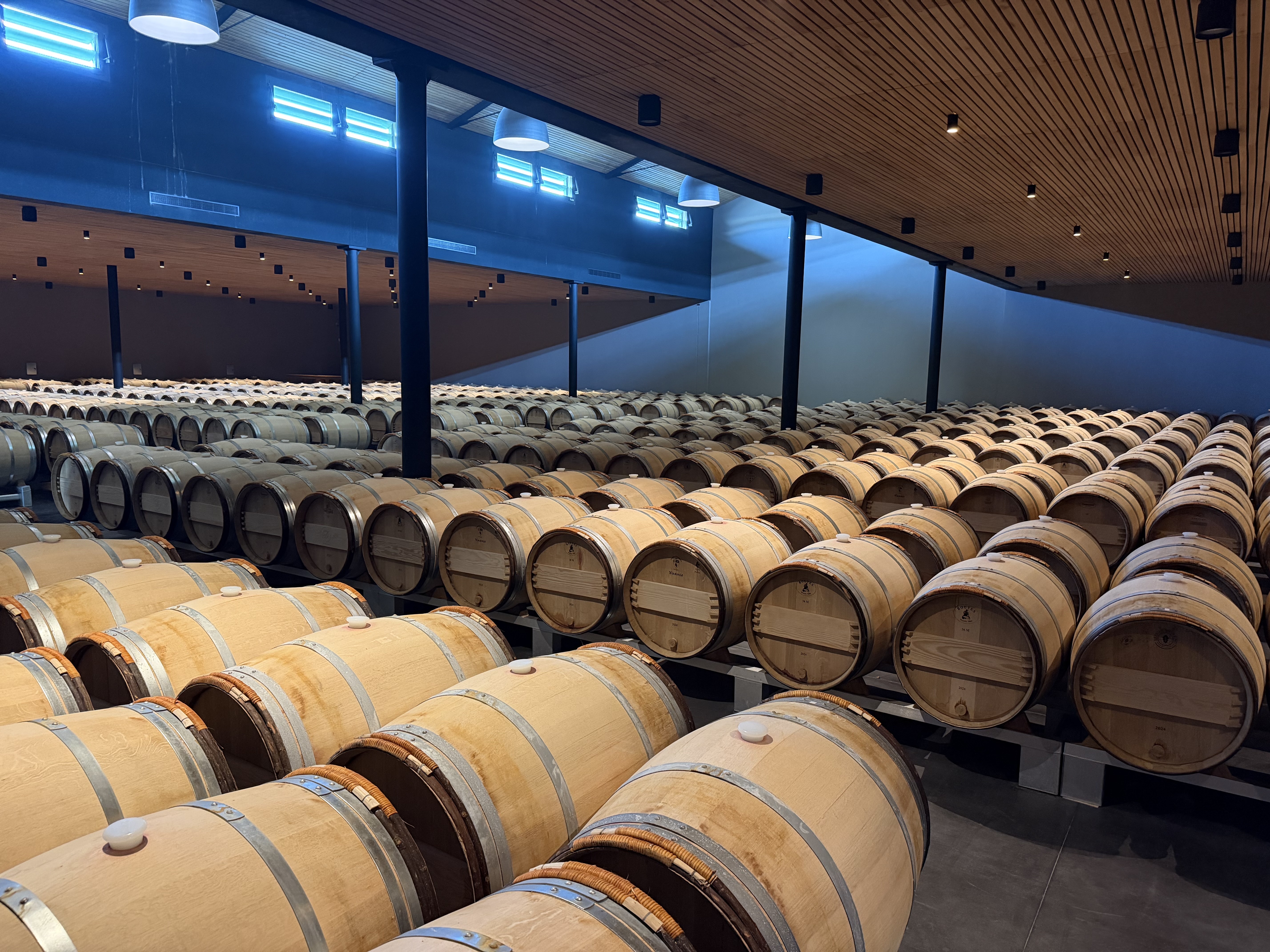 Do vines have a memory?
Beyond those obvious factors, some winemakers cited the very strong temperature differentials between day and night which helped preserve acidity. The technical director at Cos d'Estournel, Dominique Arangoïts, recalls a day in August that started at 10 degrees in the morning and reached 33 degrees in the evening. Juliette Couderc, director of operations at Château L'Évangile, puts the success of 2025 down to a mix of three things. The first is the capacity of the vines to adapt to hydric stress, for example by putting down deeper roots to search for moisture in the soil. The second is the relative absence of a lesser-known phenomenon: thermic stress, or "vapour pressure deficit," where dry air causes vines to perspire. The third is the role of the vigneron in aiding the vines to cope with the drought.
At Château Beau-Séjour Bécot, technical director Jean De Cournuaud lists the various ways in which human intervention contributed to "the challenge of preserving water in the soil" – from reducing the height of the vines to limit transpiration, to mowing only twice so that the grass between the rows does not use too much water as it regrows, not forgetting the complete absence of leaf-stripping or green harvesting in 2025.
Several of our interlocutors spoke of the ability of the vines to learn from previous experiences, both over the course of the year and from one year to the next. "The vines didn't make sugar, they learn," believes Hubert de Boüard, who adds, "There is a synergy with man, who helps them adapt, forcing the roots to plunge deeper." The consistent drought from May onwards allowed the vines to acclimatise and handle the dry conditions: "The early vintage allowed the plant to prepare for the hot, dry summer with greater resilience," explains Mathieu Cuvelier.
"A low-alcohol 2010"
A great number of estates began – and completed – their harvests at earlier dates than ever before in their history, for example Châteaux de Ferrand, Dassault, L'Église-Clinet, Montrose and Mouton-Rothschild. At others it was their earliest since 2003 – by just a single day at Château Haut-Brion or Haut-Bailly, for example. Harvesting in early September, just after the late-August rains (between around 30mm and 60mm depending on the area), meant picking grapes with sugar levels similar to those of a far more temperate vintage such as 2023, and well below the levels of 2022.
Henri Lurton, owner of Château Brane-Cantenac, puts the modest alcohol levels down to the heatwave itself, explaining that photosynthesis slows considerably above 32 degrees. Stéphanie de Boüard-Rivoal, co-owner of Angélus, elaborates: "Technical maturity came to a slight halt, and this photosynthesis pause means less sugar, which leads to moderate alcohol," adding that "the crop load in the vine and reduced recourse to green harvesting also contribute to a more measured alcohol level." Pierre-Olivier Clouet thought he was going to end up with another 2003, with potential alcohol at 14.5%, but "the 60mm of rain was like a magic wand, bringing dilution that took us to 12.7%." This is a distinctly restrained vintage in terms of alcohol content, averaging around 13.3% across the region, with top estates such as Château Lafite as low as 12.5%. "It's a low-alcohol 2010," concludes Clouet.
The 2025 is indeed more akin to a savoury, sophisticated 2010 than a luscious, exuberant 2009 or 2022. It is without overripeness or sweetness. "This is really Château Margaux," enthuses Philippe Bascaules, managing director of Château Margaux, "whereas 2022 was more 2022." Across the vines at Château Palmer, managing director Thomas Duroux states, "If I had to pick a vintage to compare it to, it would be 2016, for its balance and aromatics".
 Making monsters
What the rain could not dilute is the high tannin or polyphenol content. Many châteaux recorded their highest ever levels of IPT (indices de polyphénols totaux) – 83 at Pichon Baron or 92 at Les Carmes Haut-Brion, which its managing director calls "monstrous." At Château Cheval Blanc, the IPT stood at 78, the highest since 2010, but as Pierre-Olivier Clouet explains, "the tannin is perfectly ripe, and it is the tannin itself that provides the volume, not sugar or fat." This is what confers upon this unique vintage a clean, savoury, sophisticated directness without the overpowering richness of other hot, dry vintages.
Yet those tannins had to be handled with care. Winemakers that succeeded were those who adjusted their extraction techniques. "We have never extracted so little," declares Vincent Decup, technical director at Château Montrose, where managing director Pierre Graffeuille adds: "We didn't want to make a monster – that was a bit of a risk." At Petrus, technical director Olivier Berrouet recounts "an immense tannic mass, higher than in 2022," and underlines the importance of "gently handling the extraction, because there was so much substance passing naturally into the juice."
A tricolore vintage
The reds, then, are wines for the modern palate in more than one way: thanks to their modest alcohol levels, their savoury sophistication, their fruit-forward balance and their rose-petal delicacy, not to mention their fine, satisfying, cashmere textures. "Despite this powdery, very dense quality, it has this fresh, thirst-quenching character," concludes Nicolas Sinoquet. But nor should the whites be overlooked. After 33 years at AXA Millésimes, managing director Christian Seely declared: "It's the first vintage in my career where it is an equally great vintage for reds, dry whites, and sweet whites." Even more surprising, perhaps, than the freshness of the reds in such a hot year.
As Olivier Bernard, owner of Domaine de Chevalier, says: "I'm no longer afraid of hot vintages for making great whites; you can pick them at a very precise moment, carry out very respectful work." He continues, "I hope this will be the future direction of Bordeaux," that is to say, vintages that can be described with "defining words such as precision, elegance, finesse, charm; delicate words, not powerful ones."
2025 looks like 2035
When discussing comparable vintages with various interlocutors, Baptiste Guinaudeau, manager at Lafleur, responds with dark humour: "It's easier to compare 2025 to 2035 than to a previous vintage." It is indeed difficult to analyse this unprecedentedly extreme vintage without devoting a brief aside to 2026 and beyond. While we were in Bordeaux tasting the 2025s in beautiful hot, sunny weather, the 2026 vintage was already a week or two ahead of the 2025, and everyone we spoke to agreed that this would be the new record-early vintage. Climate change is affecting the Bordeaux vineyards exponentially. "When it's 28 degrees in April, it's briefly pleasing but then it's scary," confides Baptiste Guinaudeau, who has conducted soil tests at Lafleur whereby the difference between having water-retaining limestone soils or not gained them only six years in the face of unstoppable climate change. "The solution isn't to move north or change grape variety, we need to adapt here," he concludes.
A couple of hundred metres away, his neighbour Olivier Berrouet, at Petrus, is more sanguine: "The question we ask ourselves is our potential to continue producing great wines in extreme conditions. And we have our answer," he says. "We are delighted with the final result; we were able to achieve complexity and elegance, despite a power unmatched in recent years."
Low yields
And now the less good news: yields were down across the board in 2025. At Cheval Blanc, Pierre-Olivier Clouet saw "the smallest berry weights since records began, no more than a gram each." In many cases yields were around half their average level – 27 hl/ha versus 50 usually at Troplong Mondot, just 22 hl/ha at Margaux and Palmer, 20 hl/ha at Petrus or Léoville Barton, and even less at Cheval Blanc (15 hl/ha). Others were less affected, such as Montrose and Rauzan-Ségla, both at 30 hl/ha (still below a decent average yield).
These exceptionally low yields make it more appropriate than ever to insist upon the excellent value that Bordeaux wines represent compared to some other regions. With châteaux naturally inclined to capitalise on a fabulous vintage to reinvigorate the market, there are some reasonably priced releases worth pouncing on.
Between Ella and her colleague at Le Figaro Vin, Béatrice Delamotte, they tasted 500 wines, available here.